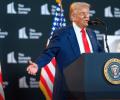
Trump said California has been particularly "hard hit" because of this, blaming democrat Gavin Newsom, the Governor of California, for this loss, calling him "weak and incompetent."

The dramatic development marked the culmination of a revolt that began with allegations of forged signatures on a letter proposing a Leader of Opposition and snowballed into an open challenge to the party leadership following the TMC's defeat at the hands of the BJP in the assembly elections.

Direct talks between the US and Iran, mediated by Pakistan, have failed to produce an agreement after 21 hours of negotiations, with disagreements over Iran's nuclear ambitions and sanctions proving insurmountable.

India has expressed strong concerns over attacks on commercial ships in the Strait of Hormuz, citing its importance to India's energy and economic security. Ambassador Yojna Patel highlighted the need to respect international law and ensure the safety of seafarers, while also addressing broader Middle East issues including the situation in Gaza and Lebanon.
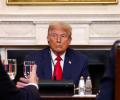
United States President Donald Trump announced a 50 per cent tariff on imports from Brazil, starting August 1, and called the trial of former Brazilian President Jair Bolsonaro a 'witch hunt', adding that the 'trial should not take place'.

The decision to hike US H-1B visa application fee to $100,000, trade talks and the GST rate cut will be the key drivers for stock market movement this week, analysts said.
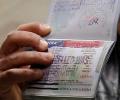
US lawmakers have expressed concerns that policies enacted by the Trump administration, such as the H1B visa fee and tariffs on India, are detrimental to American businesses and threaten the relationship between the United States and India.

Following a Supreme Court setback, Donald Trump has announced an increase in global tariffs from 10% to 15%, impacting international trade relations and raising concerns about economic repercussions.
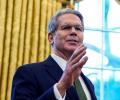
As in-person negotiations between India and the US kickstarted on Wednesday, Treasury Secretary Scott Bessent said he expected India to strike the first bilateral trade deal to avert President Donald Trump's reciprocal tariffs.
Indian and US officials will begin deliberations on the proposed bilateral trade agreement in Washington from Wednesday with an aim to iron out issues and give an impetus to the negotiations.

President Donald Trump has withdrawn the United States from over 60 international organisations, including United Nations bodies and the India-France-led International Solar Alliance, calling the institutions 'redundant' and 'contrary' to America's interests.

If the conflict continues for a prolonged period, State-run oil companies may have to review retail fuel prices accordingly.

New York City Mayor Zohran Mamdani is under fire for his handling of King Charles III's visit, particularly his call for the return of the Koh-i-Noor diamond, which has been labelled as 'rude' and inappropriate.

United States Senator Lindsey Graham on Sunday claimed that Indian Ambassador to the US Vinay Mohan Kwatra spoke to him last month about India buying less Russian oil and asked him to tell President Donald Trump to relieve the 25 per cent tariff.

Brazilian President Luiz Inacio Lula da Silva on Wednesday (local time) issued a firm response to United States President Donald Trump's announcement of a 50 per cent tariff on Brazil by invoking the country's 'Economic Reciprocity Law', while asserting Brazil's sovereignty and rejecting 'any form of tutelage' in what he described as Trump's attempts to interfere in the country's internal judicial affairs.

Representatives Deborah Ross of North Carolina, Marc Veasey of Texas and Raja Krishnamoorthi of Illinois introduced the resolution on Friday in the House of Representatives to terminate Trump's national emergency authorising tariffs of up to 50 per cent on imports from India, helping to restore Congress' constitutional authority over trade.

In the Indo-Pacific's new era -- where perception shapes reality faster than treaties -- the real entrapment is not of China or the United States. It is the test Japan has set for itself -- and whether partners like India, acting as balancers rather than accelerants, can help ensure that the story ends in stability, points out Varun Arya.
The US has temporarily permitted India to accept Russian oil already on ships to ensure energy supplies amid the conflict with Iran. This short-term measure is not expected to significantly benefit Russia financially.

The Indian government addressed opposition concerns regarding the West Asia crisis in an all-party meeting, outlining its strategy for ensuring the security of the Indian diaspora, fulfilling energy needs, and maintaining diplomatic relations with key partners. The government also dismissed Pakistan's reported mediation efforts.

The US has granted India permission to buy Russian oil already in transit to ease global supply pressures amidst the West Asia conflict. This decision comes after India agreed to halt sanctioned Russian oil purchases and substitute them with US oil.

For that to happen America does not have to lose. It only has to do the right thing, asserts Aakar Patel.
India and the US have finalised the terms of reference outlining the roadmap for negotiations of the proposed Bilateral Trade Agreement (BTA), according to a statement issued by the US. US Trade Representative (USTR) Jamieson Greer said that these ongoing talks will help achieve balance and reciprocity by opening new markets for American goods and addressing unfair practices that harm US workers.

Prime Minister Narendra Modi addressed the Israeli Parliament, reaffirming India's support for Israel in the face of terrorism and expressing support for the Gaza peace initiative.

'The next two to three weeks will not be decided in Washington.' 'They will be decided in Tehran, in whatever calculation Iran makes about the costs of continued resistance against the costs of appearing to have yielded.'
Prime Minister Narendra Modi convened a roundtable with AI startup CEOs and held bilateral meetings with global leaders at the India AI Impact Summit, focusing on AI's potential across sectors and international cooperation.

As the negotiations continued, the Iranian government said on social media that "talks between Iran and the US in Islamabad entered the expert-level stage as economic, military, legal, and nuclear committees joined in".

'We are profoundly energy-dependent on the Gulf. That dependency must now be redirected towards the United States, because we require American permission to procure oil.' 'We additionally require Iranian permission to acquire oil from that source. So India now has to seek two separate permissions merely to secure its energy supply.' 'Should we be compelled to source from America, or from Venezuela -- which is, in effect, American-controlled supply -- that will inevitably carry a price premium, an elevated shipping cost, and a considerably extended delivery timeline, given the distances involved.'
The US Representative criticised the administration's new USD 100,000 fee on H-1B visas, observing that Indians hold 70 per cent of these visas and saying the change directly harms workers who have long supported US innovation across technology, science and medicine.
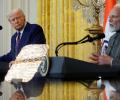
India and the US have entered a new phase in their relationship, marked by greater parity, point out Harsh V Pant and Vivek Mishra.

White House Press Secretary Karoline Leavitt said that Trump feels "very positive and strongly" about the future of India-US relationship.

Nobody takes Pakistan seriously and therefore Pakistan's sudden mediating with almost immediate results of a ceasefire seems more contrived than real, points out Vice Admiral Biswajit Dasgupta (retd).

US President Donald Trump has indefinitely extended the ceasefire with Iran at the request of Pakistan, aiming to allow Tehran's leadership time to form a unified proposal to end the seven-week war.
United States President Donald Trump has imposed a 10% tariff on most US imports, with even higher rates for China (34%), India (26%), Japan (24%) and the EU (20%), escalating a global trade war.

United States President Donald Trump on Friday withdrew the invitation extended to Canada to join the Board of Peace.

Following an examination and discussions held in the aftermath of the United States' decision to withdraw from dozens of international organisations, Israel's Minister of Foreign Affairs, Gideon Sa'ar, has decided that Jerusalem will immediately sever all contact with several United Nations agencies and international bodies, citing what the government described as persistent bias, politicisation and actions hostile to Israel.

Taking Kharg would give the US control over virtually all of Iran's oil exports and thus provide significant leverage, notes Prem Panicker in his must read daily blog on the Gulf War. It would also put American troops within range of Iran's remaining missiles, drones, and artillery on a piece of real estate that is just eight square miles in size, and just 15 miles from the Iranian mainland.

The following is the full text of US President Donald Trump's first address to a joint session of the Congress on February 28, as prepared for delivery and released by the White House press office.
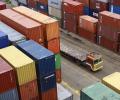
The US Trade Representative noted that India's average applied tariff rate stood at 17% per cent, the highest of any major world economy.

'...but I would not like to put a timeline to it'

The intriguing bit is that Trump is likely to attend the talks in Islamabad this weekend -- if he does, it will be the clearest signal yet that the US is ready to exit the war with some sort of win to show, since he cannot afford to go for the talks and return empty-handed, notes Prem Panicker in his must read blog on the Iran War
